 +91 98551-63355


.png)





Full Knee Replacement Surgery in Punjab – Robotic Total Knee Arthroplasty at Nagpal Robotics, Bathinda
Full knee replacement surgery — also known as total knee arthroplasty (TKA) — is the most comprehensive and definitive surgical treatment for advanced knee arthritis. When the entire knee joint has been destroyed by arthritis, a full knee replacement removes all damaged surfaces and replaces them with precision-fitted artificial components, restoring pain-free movement and full function. At Nagpal Robotics in Bathinda, Punjab, Dr. Parampreet Singh Nagpal has performed over 3,000 successful robotic full knee replacements with a 98% patient satisfaction rate — making Nagpal Robotics Punjab's premier destination for this life-changing surgery.
What is Full Knee Replacement Surgery?
In a full knee replacement, all three compartments of the knee are resurfaced with artificial components:
- Medial compartment (inner knee) — typically the most severely affected by arthritis
- Lateral compartment (outer knee) — the less affected but still involved compartment
- Patellofemoral compartment (between the kneecap and thigh bone)
The femoral condyles (bottom of thigh bone), tibial plateau (top of shin bone), and optionally the kneecap surface are all replaced with metal and plastic components. The result is a completely smooth, pain-free joint surface that can last 20–25 years with robotic alignment precision.
Full knee replacement is different from partial knee replacement (which replaces only one compartment) and knee resurfacing (which preserves more bone). It is the definitive solution for advanced arthritis affecting the entire knee.
Who Needs Full Knee Replacement Surgery in Punjab?
Full knee replacement is recommended when any or several of these conditions are present:
- Arthritis affects multiple or all compartments of the knee
- X-rays show Grade 3 or Grade 4 arthritis with severe joint space narrowing
- Conservative treatments (medications, physiotherapy, injections) have failed for 6+ months
- Knee pain is severe and constant, affecting sleep and daily activities
- Significant knee deformity (varus/bow-leg or valgus/knock-knee)
- Rheumatoid arthritis has destroyed the entire knee joint
- Post-traumatic arthritis following old fractures or injuries
- Severe bilateral knee arthritis affecting both legs
- Night pain that disrupts sleep
- Inability to climb stairs, walk short distances, or perform basic daily activities
Robotic Full Knee Replacement at Nagpal Robotics — Punjab's Most Advanced Technology
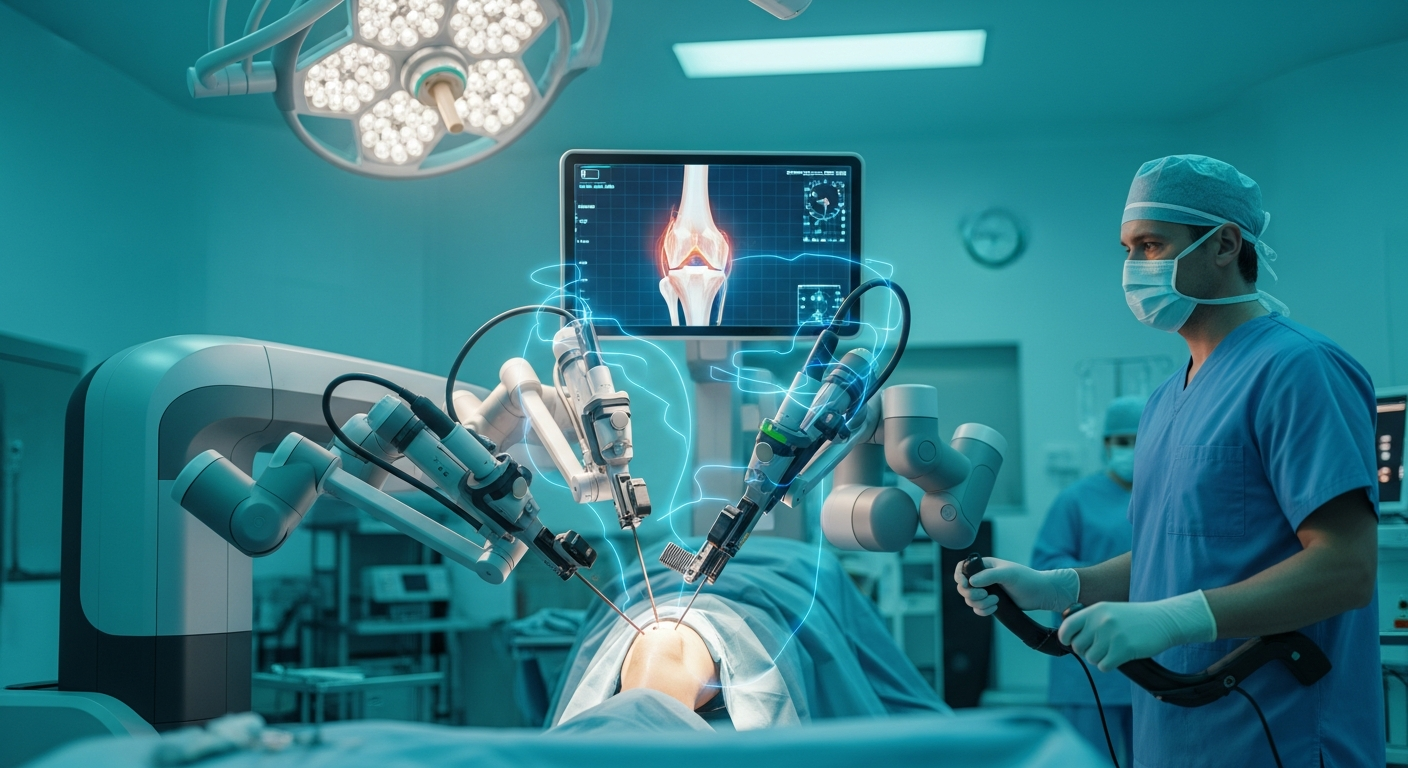
Nagpal Robotics performs full knee replacement using two advanced robotic systems — the only hospital in Punjab with this capability:
CUVIS Active Robot — Punjab's First Fully Autonomous Robot
The CUVIS system represents the highest level of robotic precision available for knee replacement surgery. A CT scan of your knee is taken before surgery, which the CUVIS software analyses to create a precise 3D model. The surgical plan — including exact implant size, position, and angle — is determined before you enter the operating theatre. During surgery, the CUVIS robot autonomously performs all bone resection within pre-programmed safety boundaries. Every cut is within 0.5mm of the plan — a level of accuracy no human surgeon can match by hand. This is Punjab's first and only CUVIS Active Robot.
CORI by Smith & Nephew — Real-Time Robotic Guidance
The CORI system is a handheld robotic device that provides real-time haptic feedback during surgery. When the surgeon's hand moves outside the pre-planned safe zone, the CORI provides resistance — physically preventing over-resection. Compatible with Smith & Nephew's comprehensive range of full knee replacement implant systems, CORI delivers excellent outcomes as either a primary or supplementary robotic tool.
The Full Knee Replacement Procedure — What Happens
Understanding the surgical process helps reduce anxiety and improves preparation. Here is a step-by-step overview of full knee replacement at Nagpal Robotics:
- Anaesthesia: Spinal anaesthesia (preferred) or general anaesthesia is administered
- Incision: A carefully planned incision is made over the front of the knee (typically 15–20cm)
- Exposure: The knee joint is opened, the kneecap is moved aside
- Robotic bone resection: The CUVIS or CORI robot guides precise removal of damaged bone surfaces from femur and tibia
- Trial components: Trial implant pieces are placed to verify fit, alignment, and soft tissue balance
- Final implant fixation: Permanent implant components are cemented in place
- Patella: The kneecap surface may be resurfaced if required
- Closure: The knee is thoroughly washed, wound closed in layers, drain placed
- Duration: 60–90 minutes for a single knee
Benefits of Robotic Full Knee Replacement vs Traditional Surgery in Punjab
- Sub-millimetre accuracy vs 3–4mm variation in conventional manual surgery
- Better balanced knee — equal tension on both sides for natural movement
- Longer implant lifespan — 20–25 years vs 10–15 years historically
- Less post-operative pain and swelling — less tissue trauma from precise cuts
- Faster return to walking — within 24 hours at Nagpal Robotics
- Lower revision surgery rates — better alignment means less wear
- More natural knee feel — optimal ligament balance achieved robotically
- Reduced blood loss — precise cuts mean less inadvertent tissue damage
Implant Options for Full Knee Replacement at Nagpal Robotics
Nagpal Robotics offers a comprehensive range of full knee replacement implants to suit every patient's anatomy, lifestyle, and budget:
- Cruciate-Retaining (CR) implants — for patients with an intact posterior cruciate ligament (PCL), provides more natural knee kinematics
- Posterior Stabilised (PS) implants — for patients whose PCL is removed, with a post-and-cam mechanism replacing PCL function
- Constrained Condylar (CCK) implants — for patients with significant deformity or ligament insufficiency
- Gender-specific implants — designed specifically for female knee anatomy, providing better fit and more natural movement
- High-flex implants — for patients who need to sit cross-legged or squat regularly (common requirement in Punjab)
- Gold (TiNbN-coated) implants — for patients with metal allergies
- Oxidised Zirconium (Oxinium) implants — for maximum wear resistance and metal-sensitive patients
Full Knee Replacement in Special Patient Groups at Nagpal Robotics
Full Knee Replacement in Diabetic Patients
Diabetes increases surgical risk — particularly infection risk and impaired wound healing. At Nagpal Robotics, diabetic patients undergo thorough pre-operative optimisation: blood sugar control, HbA1c assessment, and coordination with diabetes specialists. Special post-operative wound care and antibiotic protocols minimise infection risk.
Full Knee Replacement in Elderly Patients (70+)
Age alone is not a contraindication to knee replacement. Dr. Nagpal has successfully performed full knee replacement in patients over 80 years old. Careful pre-operative cardiac and respiratory assessment, minimally invasive anaesthesia, and early mobilisation ensure safe surgery even in very elderly patients.
Bilateral Full Knee Replacement
Both knees can be replaced simultaneously in a single anaesthetic session. This eliminates the need for two separate hospital admissions, two anaesthetics, and two recovery periods. Dr. Nagpal is experienced in bilateral robotic knee replacement, with careful attention to fluid management and blood conservation.
Full Knee Replacement for Severe Deformity
Patients with severe varus (bow-leg) or valgus (knock-knee) deformity present a more complex surgical challenge. The robotic CUVIS system's pre-operative planning allows Dr. Nagpal to plan deformity correction precisely — ensuring the knee is straightened to the correct mechanical axis while achieving perfect implant alignment.
Recovery After Full Knee Replacement at Nagpal Robotics, Bathinda
Full Knee Replacement Cost in Punjab at Nagpal Robotics
Full knee replacement surgery at Nagpal Robotics in Bathinda is priced significantly more affordably than equivalent procedures at private hospitals in Delhi (Apollo, Fortis, Max), Chandigarh, or Ludhiana. The comprehensive cost includes:
- Surgeon fees (Dr. Parampreet Singh Nagpal)
- Choice of implant (multiple tiers available to suit all budgets)
- Robotic system charge (CUVIS or CORI)
- Hospital stay (3–5 days)
- Pre-operative investigations (blood tests, ECG, CT scan)
- Anaesthesia
- Physiotherapy programme
- Post-operative medications and wound care
A written, transparent cost estimate is provided before any commitment. Call +91 98551-63355 for personalised pricing specific to your case and implant preference.
Why Punjab Patients Choose Nagpal Robotics for Full Knee Replacement
- Punjab's most experienced robotic knee replacement surgeon — 3000+ surgeries by one dedicated specialist
- Two robotic systems (CUVIS + CORI) — no other hospital in Punjab offers this
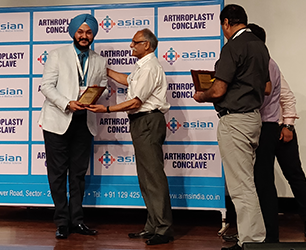
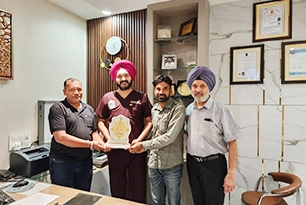
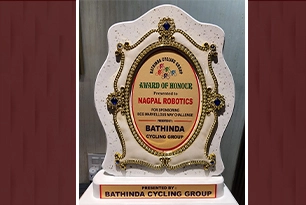
- National award-winning care — Bharat Ki Shaan Award, Shaan India Award
- Comprehensive implant range — from standard to premium, CR to PS to constrained, gold-coated, high-flex
- 24-hour walking protocol — evidence-based enhanced recovery programme
- Centrally located in Bathinda — accessible from all corners of Punjab
- Affordable pricing — world-class outcomes without Delhi price tags
- Personal care from Dr. Nagpal — not a team of juniors, but direct access to Punjab's best
Get Your Full Knee Replacement at Nagpal Robotics — Punjab's Best
Dr. Parampreet Singh Nagpal – Nagpal Robotics, Mall Road, Bathinda, Punjab
Call: +91 98551-63355 Book AppointmentFrequently Asked Questions
What is full knee replacement surgery?
Full knee replacement (total knee arthroplasty) replaces all three compartments of the knee with artificial components — the definitive treatment for advanced arthritis when all compartments are affected. At Nagpal Robotics, this is performed robotically with CUVIS and CORI systems.
Who needs full knee replacement surgery in Punjab?
Patients with Grade 3–4 arthritis affecting the entire knee, rheumatoid arthritis, or significant deformity that has not responded to conservative treatment for 6+ months.
How long does full knee replacement last?
With robotic precision at Nagpal Robotics, full knee replacement implants are designed to last 20–25 years in most patients.
How soon will I walk after full knee replacement?
At Nagpal Robotics, patients walk with a walker within 24 hours of surgery. Most are discharged home in 3–5 days.
What is the cost of full knee replacement surgery in Punjab?
Significantly more affordable than Delhi or Chandigarh private hospitals. Call +91 98551-63355 for a transparent written cost estimate specific to your case.
Is robotic full knee replacement better than conventional?
Yes — robotic surgery delivers 0.5mm accuracy vs 3–4mm variation in manual surgery. Better alignment means longer implant life, more natural knee feel, faster recovery, and lower revision rates.