 +91 98551-63355


.png)


Resurfacing Surgery in Punjab – Expert Joint Resurfacing at Nagpal Robotics, Bathinda
If you are suffering from joint pain — particularly in the knee or hip — but are not yet ready for a full joint replacement, resurfacing surgery in Punjab may be the right solution for you. At Nagpal Robotics, Bathinda, Dr. Parampreet Singh Nagpal is one of Punjab's most experienced specialists in joint resurfacing — a bone-conserving surgical technique that relieves pain and restores function while preserving as much of your natural joint as possible.
This page explains everything you need to know about resurfacing surgery — what it is, who it is for, how it is performed, and why Nagpal Robotics is Punjab's best choice for this procedure.
What is Resurfacing Surgery?
Resurfacing surgery — also called surface replacement arthroplasty — is a type of joint surgery in which only the damaged surface of the joint is replaced with an artificial implant, rather than removing and replacing the entire joint. The goal is to eliminate pain and restore function while preserving the maximum amount of natural bone.
In a knee resurfacing procedure, the surgeon removes just the thin layer of damaged cartilage and bone on the joint surface and caps it with a metal or ceramic component — similar to fitting a crown on a tooth. The underlying bone structure remains intact. This is fundamentally different from total knee replacement, where the entire end of the thigh bone and shin bone are removed and replaced.
In a hip resurfacing procedure, the femoral head (ball) is reshaped and capped with a smooth metal surface rather than removed and replaced with a metal stem. The hip socket is also fitted with a metal cup. Hip resurfacing is most commonly performed in younger, active male patients with good bone quality and no significant hip deformity.
Types of Resurfacing Surgery Available in Punjab at Nagpal Robotics
1. Knee Resurfacing (Partial or Total Surface Replacement)
The knee has three compartments. Resurfacing can be done for one compartment (unicompartmental resurfacing) or for all three (bicompartmental or total surface replacement). The specific type recommended depends on how many compartments are affected by arthritis.
- Medial compartment resurfacing — Most common. The inner part of the knee is resurfaced when medial compartment arthritis is isolated.
- Patellofemoral resurfacing — For arthritis between the kneecap and thigh bone without involvement of other compartments.
- Total knee resurfacing — All three surfaces are resurfaced without the more extensive bone removal of total knee replacement.
2. Hip Resurfacing
Hip resurfacing is offered at Nagpal Robotics for carefully selected patients with hip arthritis who are younger, active, and have excellent bone quality. The advantages of hip resurfacing over total hip replacement include:
- Larger femoral head — more natural hip movement and lower dislocation risk
- Preservation of the femoral bone — makes future revision surgery easier if needed
- Greater activity potential — many patients return to sports and physically demanding activities
- More natural hip biomechanics
Resurfacing vs Full Replacement – Which is Right for You?
Resurfacing Surgery
- Preserves more natural bone
- Less invasive procedure
- More natural joint feel
- Faster initial recovery
- Better for younger, active patients
- Easier to revise later if needed
- Best for localised/moderate arthritis
Total Replacement
- More comprehensive solution
- Best for severe/advanced arthritis
- Suitable for all age groups
- Works for significant deformity
- Longer proven track record
- More predictable outcomes
- Gold standard for Grade 4 arthritis
Dr. Nagpal evaluates each patient individually using X-rays, MRI, clinical examination, and lifestyle assessment to determine which procedure is most appropriate. There is no one-size-fits-all answer — the right choice depends entirely on your specific anatomy, arthritis grade, age, activity level, and expectations.
Who is a Good Candidate for Resurfacing Surgery in Punjab?
Resurfacing surgery is not suitable for everyone. The ideal candidate for resurfacing surgery typically has the following characteristics:
- Age: Generally under 60–65 years (though older patients may also be considered)
- Arthritis Grade: Moderate (Grade 2–3) rather than severe/end-stage (Grade 4)
- Bone Quality: Good bone density without significant osteoporosis
- Localised Damage: Arthritis mainly confined to one or two compartments
- Activity Level: Active lifestyle with desire to return to sports or physical work
- Normal or Near-Normal Alignment: No significant varus/valgus deformity
- No Significant Ligament Damage: Cruciate and collateral ligaments intact
- Weight: Normal or mildly elevated BMI
Patients who do NOT meet these criteria are better served by total knee replacement or another surgical approach. Dr. Nagpal's thorough pre-operative assessment ensures every patient receives the procedure most appropriate for their specific situation.
The Resurfacing Surgery Procedure at Nagpal Robotics
Step 1 – Consultation and Assessment
Dr. Nagpal performs a comprehensive consultation including review of X-rays, physical examination, assessment of arthritis grade and distribution, and discussion of your lifestyle goals and expectations. MRI may be requested to assess soft tissue and cartilage status.
Step 2 – Pre-operative Planning
Using CT scan data and robotic planning software, Dr. Nagpal maps out the exact amount of bone to be removed and the precise size and position of the resurfacing implant. This planning ensures that the resurfaced joint will have optimal alignment and biomechanics.
Step 3 – Surgery
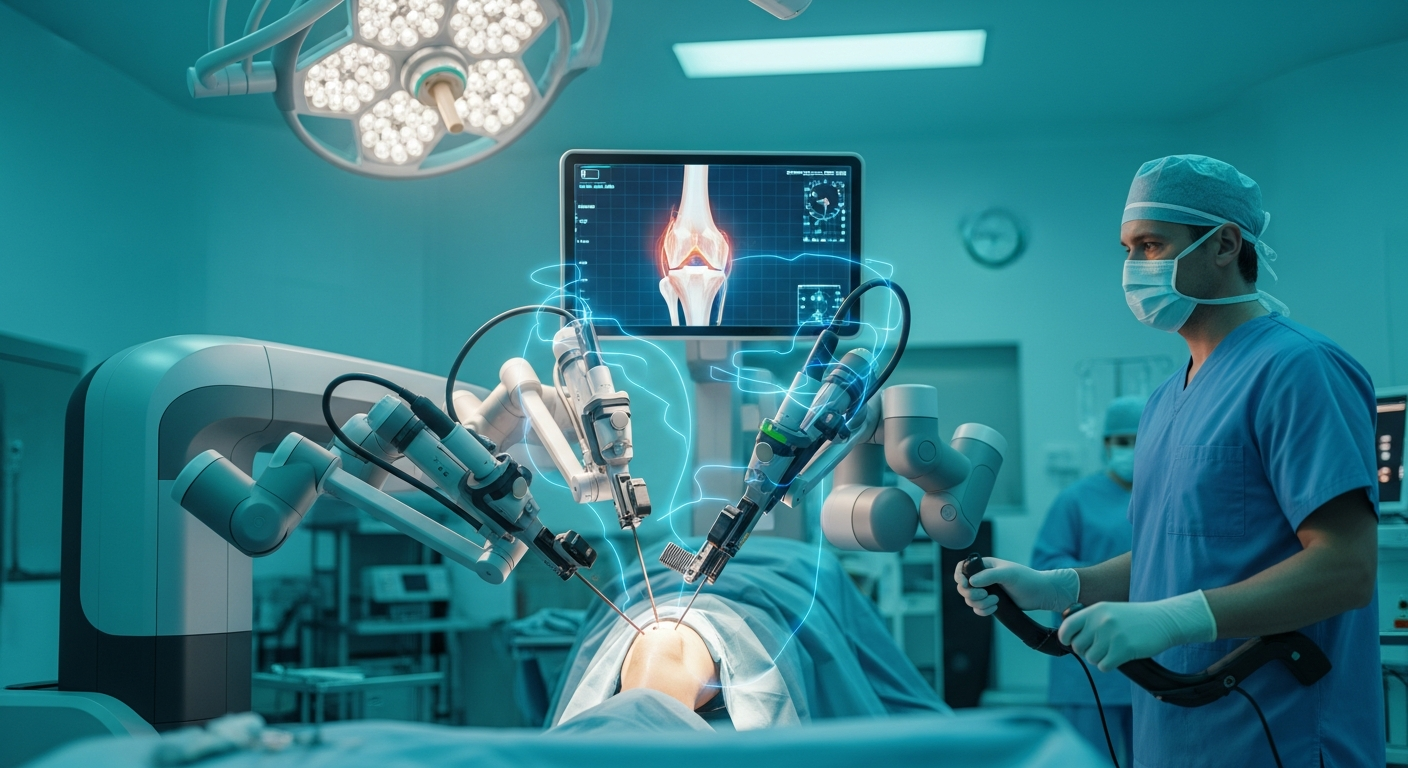
Resurfacing surgery is performed under spinal or general anaesthesia. The procedure typically takes 60–90 minutes. Dr. Nagpal uses robotic guidance (CORI system) to ensure the resurfacing components are positioned with submillimetre accuracy — the same precision available for full knee replacement.
Step 4 – Recovery
- Day 1: Walking with support within 24–48 hours
- Days 2–4: Discharge from hospital with home physiotherapy programme
- Weeks 2–6: Progressive physiotherapy — range of motion and strengthening
- Weeks 6–12: Walking normally without support, resuming daily activities
- Months 3–6: Return to sports, gym, and physically demanding work
Benefits of Resurfacing Surgery Over Total Replacement
- Bone Conservation: The most natural bone is preserved — important for younger patients who may need revision surgery decades later
- Natural Feel: Patients frequently report that a resurfaced joint feels more like their natural joint than a total replacement
- Activity Level: Many resurfacing patients return to higher-impact activities than recommended after total replacement
- Shorter Surgery Time: Resurfacing is generally faster than total replacement
- Less Blood Loss: Less bone removal means less blood loss during surgery
- Easier Future Revision: If revision is needed decades later, preserved bone makes it more manageable
Resurfacing Surgery Cost in Punjab
The cost of resurfacing surgery at Nagpal Robotics, Bathinda is significantly more affordable than equivalent procedures in Delhi or Chandigarh private hospitals. The total cost covers:
- Surgeon's fee (Dr. Parampreet Singh Nagpal)
- Implant cost (premium resurfacing components)
- Operating theatre and robotic system charges
- Hospital stay (2–4 days)
- Pre-operative investigations
- Anaesthesia
- In-patient physiotherapy
- Post-operative medications
Call +91 98551-63355 for a transparent written cost estimate specific to your case.
Consult Punjab's Expert for Resurfacing Surgery
Dr. Parampreet Singh Nagpal – Nagpal Robotics, Mall Road, Bathinda, Punjab
Call: +91 98551-63355 Book AppointmentFrequently Asked Questions
What is resurfacing surgery and how is it different from knee replacement?
Resurfacing surgery replaces only the damaged surface of the joint, preserving the underlying bone. Total knee replacement removes and replaces the entire joint end. Resurfacing is less invasive and better for younger patients with moderate, localised arthritis.
Am I suitable for resurfacing surgery?
You may be suitable if you are under 65, have moderate arthritis affecting one or two compartments, have good bone quality, no significant deformity, and an active lifestyle. Dr. Nagpal will assess your suitability at consultation.
How long does resurfacing surgery last?
Resurfacing implants are designed to last 15–25 years in appropriately selected patients. The longevity depends on patient factors including activity level, weight, and bone quality.
Can I return to sports after resurfacing surgery?
Many patients return to low-impact sports such as swimming, cycling, and golf within 3–6 months. Some return to higher-impact activities. Dr. Nagpal will advise on appropriate activities based on your specific implant and recovery.
Where is the best place for resurfacing surgery in Punjab?
Nagpal Robotics, Mall Road, Bathinda, Punjab — with Dr. Parampreet Singh Nagpal, robotic guidance, and the most advanced pre-operative planning technology in the state.