-
 +91 98551-63355
 - nagpaljointclinic@gmail.com
+91 98551-63355


.png)


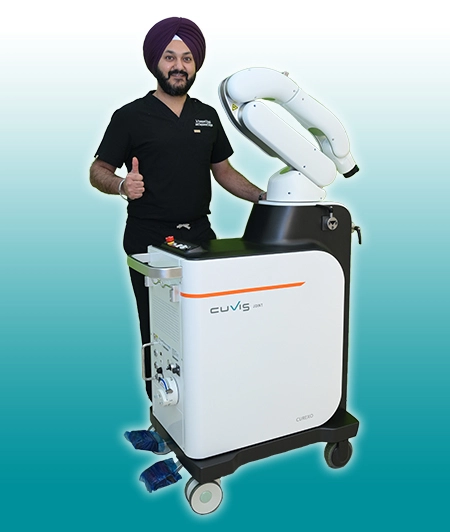
Dr. Parampreet Singh Nagpal is Northern India's first joint surgeon who operate with 2 different joint robots under one roof. One is Cuvis by Maxx Meril(Punjab’s first fully Active Joint Robot) and another one is Cori by Smit & Nephew(Semi Active Joint Robot). Now patients have 6 different implant options to choose from with 2 Robots. Nagpal Hospital's hardworking Orthopedic team has done more than 13000 successful Joint Surgeries.

Knee joint replacement is a procedure that involves replacing an injured or ailing knee with an artificial joint, or prosthesis. During the procedure, which lasts between one and two hours, your surgeon will make a long surgical cut above your knee. With the skin and muscle pulled back, they’ll cut away damaged cartilage and bone. They’ll affix the new knee joint to your femur, or thighbone, and tibia, which is the main bone in your lower leg. They’ll do this using specialized cement, pins, and screws. Afterward, your surgeon will close the incision wound with stitches and apply a bandage.
With the increasing cases of Arthritis, Rheumatoid, and Osteoarthritis, knee pain leading to knee replacement surgeries is at a rise. In a scenario like this, a breakthrough technology is an all-time boon that can help surgeons perform the surgery without the scope of manual or miscalculated error and help patients get the best of outcomes. To address the requirements of both patients and surgeons, CUVIS Robot, Punjab’s first fully active robot for knee replacement surgery is here at Nagpal Superspeciality Hospital, Bathinda.

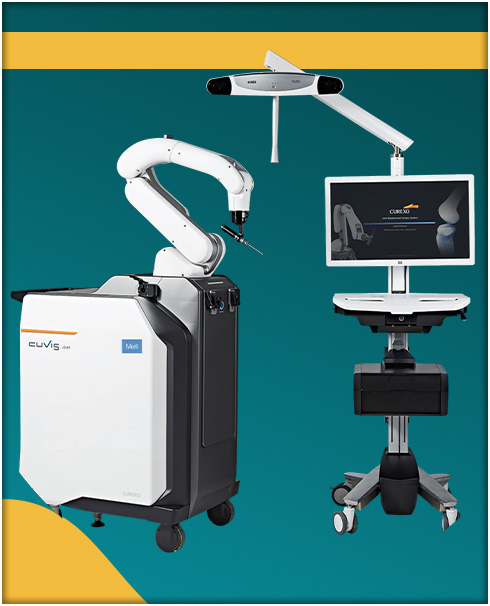
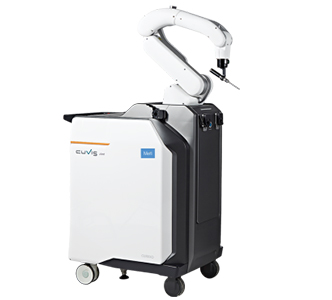
Cuvis Joint Robot System is the most advanced surgical cutting edge robotic technology supporting surgeons with Personalized Preplanning and Precise Cutting for predictable and consistent results. It is made up of three key components: the Main Console, the Robotic Arm, and the Planning Device. The Main Console with Optical Tracking System (OTS) aids in real-time monitoring and directs the surgeon through the procedure. The majority of the bone cutting is done by a robotic arm with a milling tool positioned on its tip.
The CUVIS Joint Robot creates a 3D model of the patient's knee, which the surgeon utilizes as a guide to make correct bone incisions and precisely place the knee components.
Personalized pre-planning: The doctor uses 3D pictures of the patient's joints to arrange the operation specifically for each patient.
Pre-selection and exact insertion of artificial joint: The doctor utilizes the robot to choose and precisely install an artificial joint for the patient.
Precise cutting for accuracy and optimum alignment: The robot analyses the data and accurately slices the bone in relation to the dimensions of the pre-selected implant.

CUVIS JOINT is completely independent, whereas the other robots work as a helping hand. The robotic technologies present at the moment can be categorized as passive or semi-active devices but CUVIS Joint is a fully active robot. The others does have a robotic arm but is passive, the surgeon holds the same and performs the cutting of bone area.
Nagpal Superspeciality Hospital has always strived to serve patients with superior care supported by up-to-the-minute technology. CUVIS Joint Robot System is a step towards our mission. With this next level of technology, we seek to empower our surgeons and benefit our patients at the same time. In turn, bringing the change in the face of joint replacement surgeries. Make an appointment to learn more.
Advanced Knee Replacement Surgery in Bathinda for Arthritis, Severe Knee Pain & Mobility Issues
If knee pain is stopping you from walking comfortably, climbing stairs, sitting cross-legged, or even sleeping peacefully—this is not “normal ageing.” It’s a sign your knee joint may be damaged due to arthritis, cartilage wear, or deformity.
At Nagpal Robotics (Nagpal Hospital, Bathinda), we provide advanced knee replacement surgery options—including robotic knee replacement—focused on precision, faster recovery, and long-term stability.
📍 Nagpal Hospital, The Mall Road, Bathinda, Punjab
📞 Call: 98551-63355 | 98555-63355
Get a proper evaluation from an experienced Orthopedic Surgeon in Bathinda and know the best knee surgery option for you.
📞 98551-63355 | 98555-63355
✅ Same-day appointment support (as per availability)
✅ Guidance on surgery type, recovery plan & implant choices
Knee replacement is a proven orthopedic procedure designed to relieve long-term knee pain caused by joint damage. During surgery, the damaged surface of the knee is replaced with an artificial joint component that restores smoother movement and helps you return to daily activities.
Knee replacement may be advised when:
Nagpal Robotics provides complete knee replacement care in Bathinda—from evaluation and imaging guidance to surgery planning and post-operative rehabilitation support.
Most patients who search “knee doctor near me” or “best knee replacement surgeon in Bathinda” are dealing with one of these conditions:
Osteoarthritis (Most Common)
Cartilage slowly wears away, leading to bone friction, swelling, stiffness and pain.
Rheumatoid Arthritis
Inflammatory joint disease that damages cartilage and bone over time.
Post-Traumatic Arthritis
Develops after injury, fracture, ligament tears or meniscus damage.
Knee Deformity (Bow Legs / Knock Knees)
Changes in alignment increase pressure on one side of the joint and accelerate wear.
Failed Previous Treatments
When medicines, physiotherapy, injections or supports no longer provide relief.
Not every patient needs the same type of surgery. A key reason patients choose a dedicated knee clinic is to understand the right option rather than a one-size-fits-all approach.
Recommended when arthritis affects multiple compartments of the knee joint and pain is severe.
Suitable when damage is limited to one compartment and the rest of the knee is relatively healthy.
A precision-enhanced partial replacement option where robotic assistance supports accurate planning and placement.
Both knees treated during a single planned procedure for selected patients after clinical assessment.
High-quality implants designed to restore movement and support daily lifestyle needs.
The final decision should be based on clinical evaluation, imaging findings, knee stability, alignment and patient activity expectations.
Robotic knee replacement is an advanced form of knee replacement surgery where robotic technology assists the surgeon in achieving accurate alignment and precise implant positioning.
(Recovery varies by patient health, arthritis stage, and rehabilitation adherence.)
CUVIS Joint Robot System is an advanced fully active robotic platform supporting surgeons with personalized preplanning and precise cutting for predictable and consistent outcomes.
CORI is a semi-active handheld robotics-assisted platform used for total and unicompartmental knee replacement procedures. It is developed by Smith + Nephew and supported by a digital planning ecosystem.
At Nagpal Robotics, advanced surgery is supported by a clean, safe, and patient-focused hospital environment. From admission to discharge, every step is designed for comfort, safety, and recovery.
Recovery is a structured process. Good outcomes depend on both surgery quality and rehabilitation discipline.
✅ Patients who follow physiotherapy consistently typically progress faster and safer.
Dr. P.S. Nagpal is a senior Orthopedic Surgeon known for extensive experience in knee replacement surgery.
Patients across Punjab trust Nagpal Robotics for precision joint care and advanced knee replacement solutions.
Patients visit Nagpal Hospital from: Bathinda, Mansa, Muktsar, Faridkot, Barnala, Dabwali, Abohar, Giddarbaha, Rampura Phul, Maur Mandi and nearby areas.
If you are searching for:
You are at the right center.
Speak with our team and schedule your knee evaluation appointment.
Doctor evaluates knee condition through examination and imaging.
A customized treatment and recovery roadmap is created.
Get a clear recommendation after a proper knee evaluation.
📞 Call: 98551-63355 | 98555-63355
Book Knee Evaluation1) When is knee replacement recommended?
When arthritis damage causes persistent pain, stiffness and functional limitation despite conservative treatment.
2) Is robotic knee replacement better than traditional surgery?
Robotic assistance can improve planning and precision of implant placement. Suitability depends on case assessment.
3) Can I get partial knee replacement instead of total?
If damage is limited to one compartment and knee ligaments are stable, partial replacement may be considered.
4) How long does knee replacement recovery take?
Recovery varies, but physiotherapy-driven improvement typically continues over weeks to months.
5) Do both knees need surgery together?
Bilateral knee replacement can be considered in selected patients based on fitness and surgeon’s evaluation.
6) Will I be able to walk normally after surgery?
With successful surgery and proper rehab, most patients aim to return to comfortable walking and daily activities.
Get expert guidance from a trusted knee doctor in Bathinda.
📍 Nagpal Hospital, The Mall Road, Bathinda
📞 98551-63355 | 98555-63355
Nagpal Robotics (Nagpal Hospital)
The Mall Road, Bathinda, Punjab
📞 98551-63355
📞 98555-63355
◐ Up to 20% of patients remaining dissatisfied following TKA.
◐ Human controlled variables affecting outcome in TKA
◐ Conventional jig-based TKA uses preoperative radiographic films, intra-operative anatomical landmarks, and manually positioned alignment jigs to guide bone resection and implant positioning.
◐ Conventional jig-based TKA is associated with poor reproducibility of alignment-guide positioning, inadvertent saw blade injury to the periarticular soft-tissue envelope, and limited intra-operative data on gap measurements or ligamentous tensioning to fine tune the implant positioning.
◐ Suboptimal implant positioning may lead to
◐ In navigated TKR, computer software converts anatomical information obtained from intra-operative osseous mapping into a virtual patient-specific 3D model of the knee joint.
◐ Virtual model is used to plan optimal bone resection, implant positioning, bone coverage, and limb alignment based on the patient’s unique anatomy.
◐ Computer navigated TKA provides patient-specific anatomical data with recommendations for bone resection and optimal component positioning.
In robotic TKR, a robotic device helps to execute this preoperative patient-specific plan with a high level of accuracy.
◐ Robotic TKR uses optical motion capture technology to assess intra-operative alignment, component positioning, range of movement, flexion-extension gaps, and soft tissue balancing.
◐ RTKR actively controls and/or restrains/eliminate the surgeon’s motor function to improve the accuracy of achieving the planned bone resection and implant positioning.
◐ Real-time intra-operative data can then be used to fine-tune bone resection and guide implant positioning, in order to achieve the desired knee kinematics and limit the need for additional soft tissue releases.
◐ RTKR associated with improved accuracy of achieving the planned femoral and tibial implant positioning, joint line restoration, limb alignment, and posterior tibial slope compared with conventional jig-based TKA.
◐ Results in improved accuracy in implant positioning in all three planes and reduces outliers.
Powered by Nagpal Robotics @2026
Created With ❤️ By Digital Dots